
The Storyteller Project: Week 4
Embracing Family History Stewardship

Embracing Family History Stewardship
Suggested Reading: Part 4: Write The Stories — Chapters 15, 16, and 17
Overview:
Chapter 15 makes the case for writing over holding, not as sentiment but as science. Memory is not a filing cabinet. It reconstructs every time it is accessed. What lives only in you is a single fragile copy. Chapter 16 is the anchor story: Howard Hinkson Convers, who wrote down what he knew about Richard Summers Hinkson and in doing so handed forward someone who would otherwise have been only a name on a chart. Chapter 17 names the threshold precisely: holding and preserving are not the same thing. Preservation is translation, decoupling the meaning of the records from your own memory and putting it on the page.
This prompt is about starting the story. Some of us have collections in progress. Others are searching for that starting point. Whether this is your first story, or the 100th story, I invite you to see your next story through the lens of: One scene. One person. One moment.
Prompt:
You already know which story you are holding. The story that is most at risk of disappearing because the only place it currently lives is in you. For this prompt you’ll be thinking in terms of a moment. Choose a moment in time for one ancestor, in one setting, within the context of one historical time or event. Like this:
Choose one ancestor: Who was she or he? What was their basic life data? Birth-Death. - this is not your story, it’s context. “Ruth Convers, born 1880 in Volcano, California; died 1946 in Turlock, California.” Who were they with? “Her husband and children.”
Choose one historical event to anchor this moment to: What was happening in the world? Their country? Their local community? “World War II”
Choose one setting: Not their entire lives. Just one moment. (This is the hard part. This is a transition from looking at an entire life story and wanting to capture from birth to death, to an intimate moment that truly allows your readers to know your ancestor.)
Where were they? “At the kitchen table, eating dinner.”
When was it? “The day before her son had to report to duty.”
That’s it. Just start the story with this prompt. You don’t have to tell the story yet. Just set the intention for this story so it has a starting place in your mind.
Share 1 through 3 of the prompt in the chat.
Add your experience with the process too. I encourage you to comment on at least one other person’s comment. Conversations about what this process means to you will help others and solidify your conviction to move forward in writing the story.

Get the book:
Stewardship Matters: A Storyteller’s Guide to Preserving Family History.
Get: Ebook PDF (With Paid Subscription to GenStack Coterie).
Get Paperback: Paperback (Buy on Lulu)
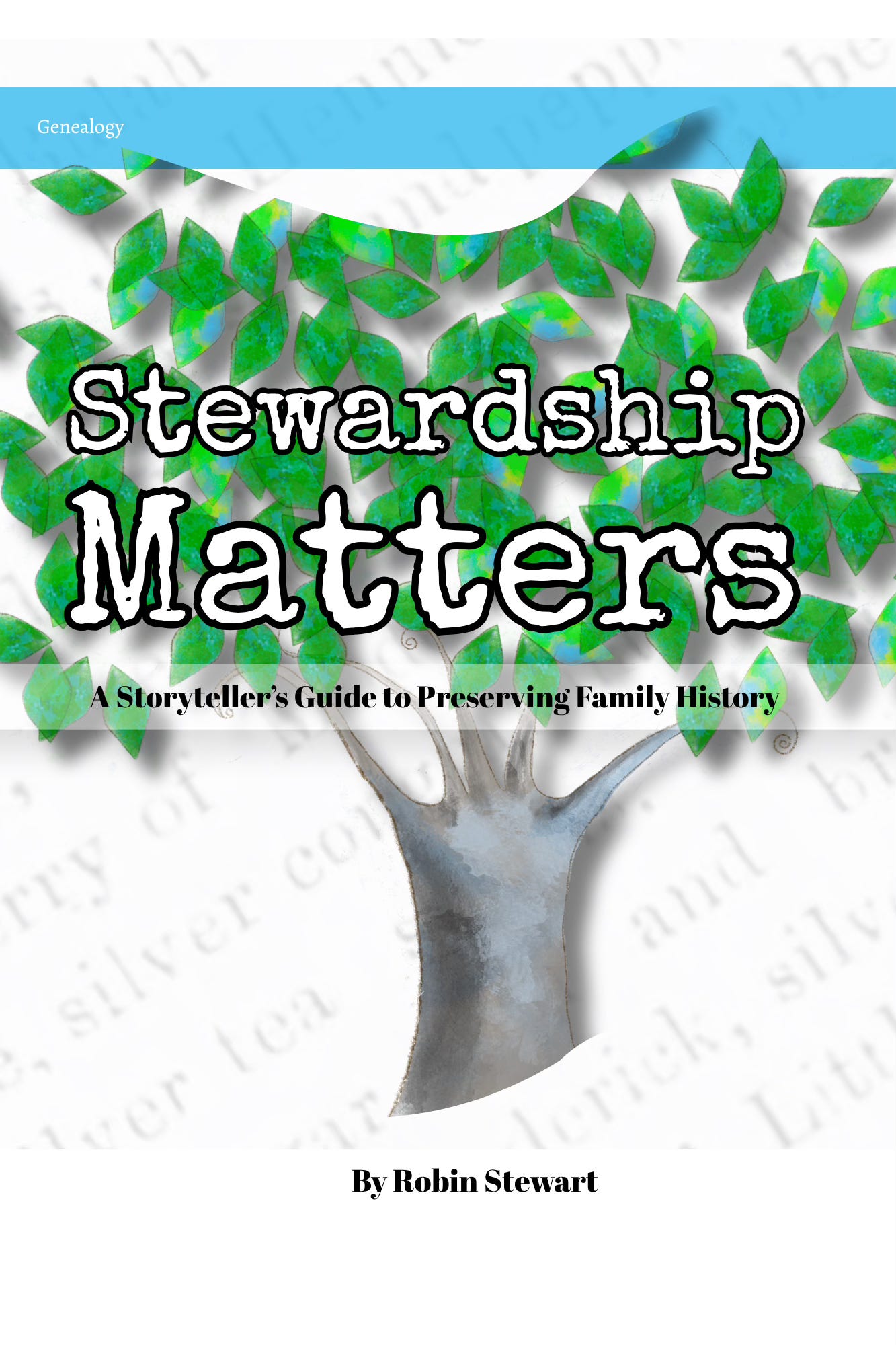
Paid subscribers to Genealogy Matters or GenStack Coterie have access to the digital version.